




Practical tips for using nonprofit storytelling to connect with donors and grow your mission
Nonprofit organizations do essential work every day. They offer relief, provide urgently needed services, strengthen communities, and improve lives in ways many people never see firsthand.
From a fundraising perspective, it can be easy to “see” the impact of this work by what the numbers tell us. But numbers alone aren’t enough to inspire your donors, who want to understand exactly what your organization is doing, who you’re helping, and how their support makes a difference.
Strong impact stories translate outcomes into compelling narratives your donors can picture, feel, and remember. They give emotional shape to your mission and build deeper, human-driven connections. And when done well, they provide the foundation for effective nonprofit storytelling across all of your fundraising communications.
Impact spotlight: New Leash on Life USA

The Philadelphia-area nonprofit New Leash on Life USA is a prison-based dog training program that provides second chances to incarcerated individuals and at-risk dogs. While forming life-changing therapeutic bonds between humans and animals, the organization offers life skills and career readiness training that prepares participants for reentry, reduces the risk of recidivism, and increases likelihood of adoption.
New Leash on Life USA provides a powerful model of effective nonprofit storytelling, because its mission can be distilled to a simple and compelling narrative of mutual transformation. As the organization states on its website: Together, they rescue each other.
This guide walks you through the fundamentals of writing compelling impact stories, how to use nonprofit storytelling in your multichannel fundraising strategy, and where to share stories to inspire deeper generosity.
Why do nonprofit impact stories matter?
Impact stories influence how donors understand your work and decide to support it. They shape perception, build trust, and create an emotional connection to your mission.
Here are three reasons impact stories are an important part of your fundraising strategy.
1. They make your mission concrete
Many nonprofits address large, complex challenges. Issues such as poverty, animal welfare, recidivism, healthcare, and education reform can be difficult for donors to visualize without context.
Impact stories help by narrowing the focus to personal, tangible outcomes. They highlight one moment of change that represents the impact of your larger mission. New Leash on Life USA, for instance, illustrates the transformative impact of its work by highlighting specific success stories of individuals and dogs who have gone through its program.
2. They strengthen donor trust
Donors want confidence that their gifts lead to meaningful outcomes. Impact stories create that confidence when they combine human experience with measurable results.
New Leash on Life USA boasts clear proof points, including a 72% employment rate and 100% adoption rate among program participants. These numbers reinforce the narrative of transformation and demonstrate the effectiveness of their programs.
When your nonprofit storytelling includes specific outcomes, supporters can see the connection between their generosity and the positive results of your mission.
3. They drive engagement across channels
Impact stories fuel email campaigns, social media posts, annual reports, peer-to-peer fundraising pages, and online donation forms.
Instead of inventing new content for every platform, you can build around the same core story in multiple formats. That consistency strengthens recognition and reinforces your messaging over time.
How do you prepare to write impact stories?
Compelling impact stories begin with careful preparation. A clear foundation makes the writing process far easier—and more effective—and ultimately ensures your nonprofit storytelling corresponds with your larger planning and strategic goals.
Because impact stories tie fundraising goals to specific program outcomes, collaboration is key. Be prepared to work with colleagues outside of development—programs, communications and marketing, executive leadership, and even volunteers—to gather all the information you need to tell your story.
Here are some key steps to take before you start writing.
Know the larger story of your organization
Each impact story fits within a broader narrative about your mission, vision, and values. This story includes not only the current work you do, but the history of your organization and how you came to be where you are now.
Before drafting, clarify:
- What problem are you solving?
- Who benefits from your programs?
- What metrics and outcomes define success?
- What makes your approach distinct?
- What should donors understand after reading this story?
Audience matters as well. A development director may be addressing long-time or major donors who expect data and measurable progress. A communications manager may be creating content for a broad social media audience that needs clarity and immediate connection.
Use data to measure tangible impact
As mentioned above, the strongest nonprofit storytelling combines compelling narrative with tangible, measurable outcomes. Impact metrics can also help you identify where your organization’s most important stories are.
To get started, gather meaningful data such as:
- Number of beneficiaries served
- Program completion or success rate
- Long-term program outcomes
- Hours of service or programming provided
- Growth milestones
- Community impact indicators
Clear data points lend credibility to your impact stories and make it easier to demonstrate progress year over year.
When you support your organization’s programming with a robust nonprofit CRM, you can track and report on revenue goals tied to specific impact outcomes—ensuring all of your nonprofit data is aligned.
Track the data behind your impact stories.
Strong impact stories begin with reliable data. With DonorPerfect’s customizable reports and real-time dashboards, you can track program participation, give trends, campaign performance, and key impact metrics all in one place.

How do you write compelling impact stories?
With preparation complete, you’re ready to tell your story. Here are a few nonprofit storytelling fundamentals to guide your writing.
Impact story checklist
Include these basic elements in every impact story:
- The beneficiary impacted
- The change that occurred
- The role of the donor
- An illustration of impact (e.g, quote, photo, video)

Make it personal
Donors are inspired by stories that connect people with data. Start with one person, community, or breakthrough moment as the entry point for your story. From there, you can expand to show how that experience reflects a broader, measured impact.
For New Leash on Life USA, the story of an individual dog or participant emphasizes the uniqueness of each experience while illustrating how the organization’s reentry program is successful at scale. The data matters, too—but donors are more motivated to give when the numbers are attached to a personal and emotionally resonant story.
Build a clear narrative arc
Every good story has a clear beginning, driving action, and conclusion. Your impact stories should follow the same basic narrative structure, with a few additional key details.
Try this progression:
- Introduce the beneficiary and their starting point.
- Describe the challenge to overcome.
- Explain your organization’s assistance or intervention.
- Illustrate the outcome.
- Connect the outcome to wider impact.
Using this framework will keep your writing focused and persuasive.
Invite donors to play a role
The purpose of nonprofit storytelling is to connect donors with your mission—and the best way to do that is to show them where they fit into the story.
Use language that acknowledges donor engagement and connects it directly to specific outcomes. Then provide a clear next step, whether that be donating, becoming a member or monthly supporter, attending an event, or simply sharing the story.
New Leash on Life USA provides an inspiring example with Ruth’s Fund, a memorial fund created to honor the legacy of a founding board member and devoted animal foster. The fund has its own dedicated webpage, with a short biography, a statement of the honoree’s impact, and before and after photos of Rumple—a formerly at-risk dog who has benefitted from the fund. At the bottom of the page is the invitation—Help us continue Ruth’s legacy of compassion and generosity toward those who need our help the most—and a button to donate.
Use a variety of formats
A single impact story can be repurposed in various shapes and sizes. Think about the formats that would resonate most with your audiences, as well as what would work best for the platforms you use. Write versions of varying lengths, and consider how visuals and audio can help you tell the story.
One impact story can be told as a(n):
- Long-form narrative
- One-paragraph blurb
- Formal appeal letter
- Email campaign
- Photo essay
- Quoted testimonial
- Series of infographics
- Video clip
- Short documentary film
- Podcast
Pro tip: You don’t have to reinvent the wheel. Use nonprofit AI to creatively adapt your long-form impact story to a variety of lengths and formats. DonorPerfect’s free Fundraiser Bot can help!
Looking to learn more about fundraising with AI? Download AI for Nonprofits: A Fundraising Communications Guide for expert tips on using AI to streamline your campaigns, web content, and operational workflows.
Where can you share impact stories?
After you’ve created your impact stories, it’s important to be intentional about how you distribute them. Where will they reach the audiences who need to see them? What are the benefits and limitations of each channel?
An effective (and efficient) fundraising communication strategy tells one unified story across multiple outreach channels.
Your nonprofit website
Your nonprofit’s website is the primary window into your work and mission. For many donors, it may be the first place they learn about your organization or the final proof of credibility that convinces them to give—so every page counts.
Your website also offers you the most flexibility to mix up the length and format of your impact stories. Consider using a combination of long-form storytelling, high-impact photos and videos, and quick blurbs.
You can include impact stories on your website’s:
- Homepage
- Program descriptions
- Testimonials
- Thank-you page
- “Get Involved” page
- Blog posts
If capacity allows, it’s also a great idea to have an entire page dedicated to impact. New Leash on Life USA’s website includes a prominent “Impact” page that provides a brief description of their approach and outcomes, key impact stats, a five-minute video, and individual success cases that visitors can click into for full stories.
Impact stories are powerful in writing, but they’re even more compelling when supporters can see the faces, hear the voices, and experience the emotions behind every success.
Your online donation forms
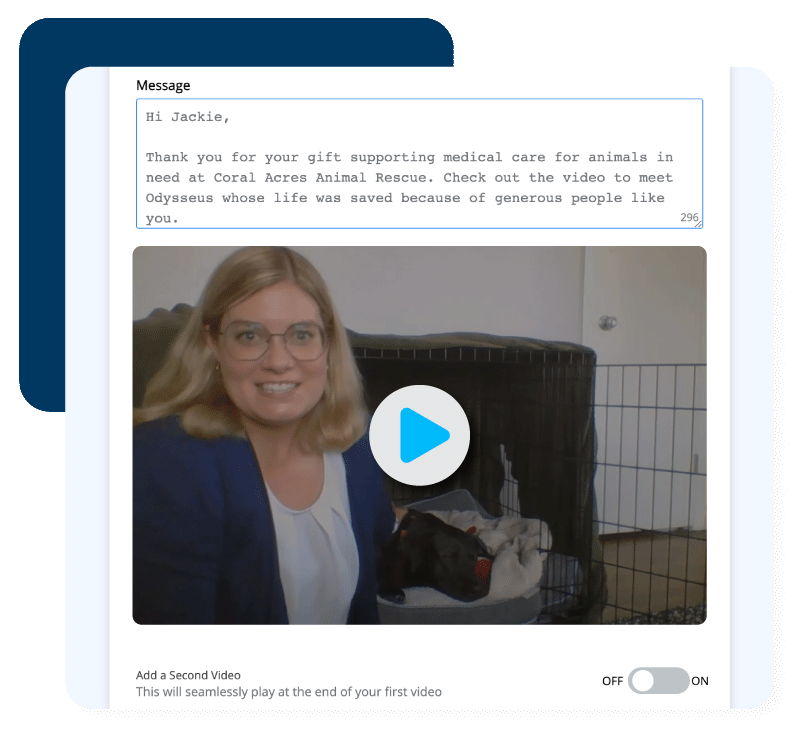
A donation form is not simply another page on your website. It’s a critical piece of your online fundraising strategy that can make or break gift completion. If a donor has made it to your fundraising website, they’re already inspired; a compelling form sustains that inspiration and shows the donor what their generosity will make possible.
Space is limited, so be strategic about how you tell your story. Aim for quick, easy-to-read text and bold images. The look, feel, and messaging should be consistent with the storytelling that inspired your donor to click “Donate.”
Consider including these in your online donation form:
- Branded colors
- A compelling banner image
- Impact descriptions at each giving level
- A beneficiary photo
Turn your donation forms into impact stories.
When you use DonorPerfect with Givecloud, you can design high-converting online forms that let donors select the outcomes they care about most. With visual, choice-based giving experiences, help your supporters become a part of the story in just a few clicks.
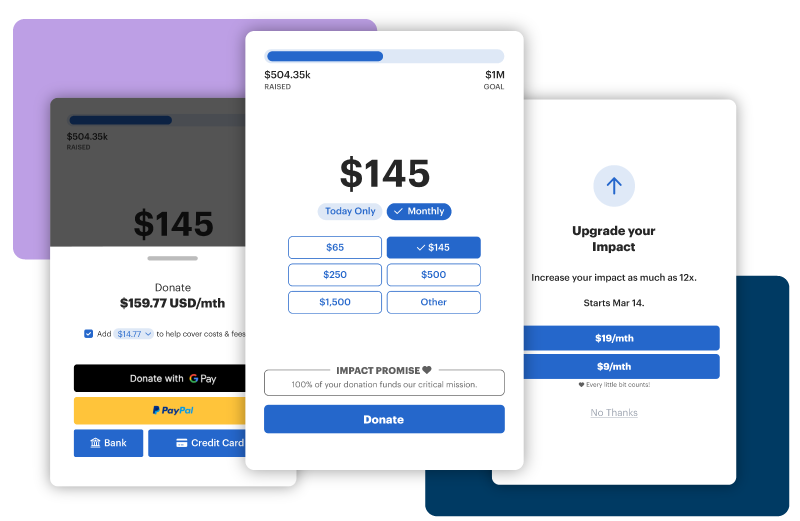
And don’t forget—the story doesn’t end after the gift! Consider including impact stories on your gift confirmation pages and automated thank-you emails to ensure your donors stay connected.
Email campaigns
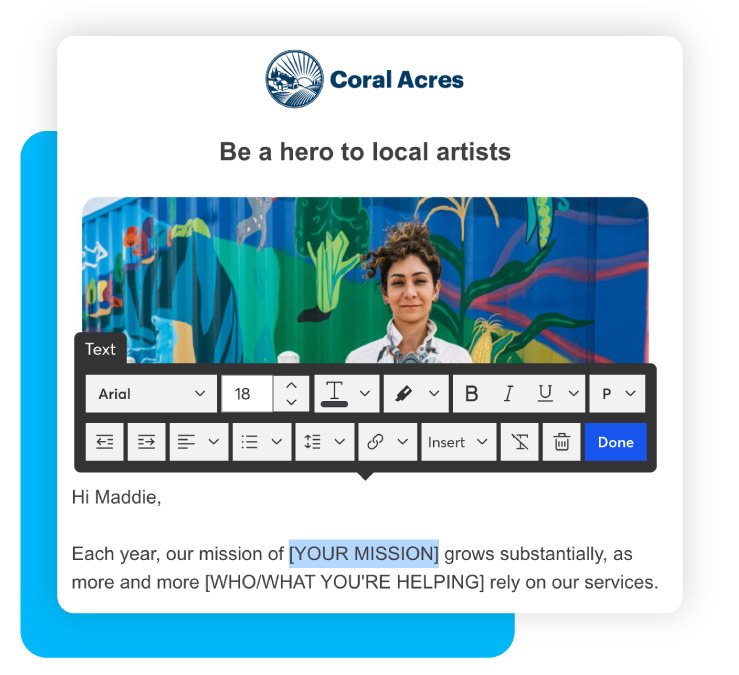
Your email campaigns are one of the most important places to use impact stories. Donors are more likely to open and click through a fundraising email when it makes an emotional appeal that tells them who will benefit from their support and how.
A strong campaign uses one impact story and shares it in a few different ways, highlighting the problem, the outcome, and the donor’s role. New Leash on Life USA is a great example of how one program or service can provide multiple story angles—from a dog’s journey to adoption, to a participant gaining skills and stability, to measurable outcomes like adoption success and reduced recidivism.
Here’s a potential campaign sequence:
- Email 1 – The problem and the human story
- Email 2 – The outcome your organization creates (with supporting data)
- Email 3 – The urgent need and the donor’s role
- Email 4 – A brief narrative reminder with a prominent call to action
Telling the same story from different angles creates a cohesive campaign without repeating the same information from one email to the next.
Bring your impact stories to more donors with DonorPerfect + Constant Contact
Impact stories work best when they reach the right people at the right time. With DonorPerfect + Constant Contact, you can use donor data and segmentation to tailor your nonprofit storytelling by interest or engagement, then deliver it through email, social posts, and SMS from one platform. You also get consolidated campaign reporting so you can see what’s resonating and keep improving the impact stories donors respond to most.
Social media
Nonprofit social media can connect your organization with a wider audience using a variety of engaging formats—photos, designed infographics, and video. It also provides a natural way to develop impact stories over time in short, digestible snippets.
Use social media for:
- Weekly impact highlights
- Volunteer spotlights
- Program updates
- Behind-the-scenes features
- Short success stories
And don’t forget: social media is for sharing! Encouraging supporters to share your impact stories with their own communities is a simple way to grow participation and reach—even between fundraising campaigns.
Your annual report
As a narrative summary of the year’s activities and accomplishments, your organization’s annual report is a prime opportunity for nonprofit storytelling. Where did you begin, what strategies did you implement, and which programming and fundraising goals did you achieve?
Your donors, board members, and other stakeholders won’t be inspired by dry data charts and lists of activities. Instead, organize the annual report around key impact stories that best illustrate your organization’s successes and use data to support the narrative.
Are you writing your nonprofit annual report—or just want to prepare in advance? Check out our blog to learn our favorite tips for writing an annual report that informs and inspires.
Read now: Writing the Nonprofit Annual Report: Dos and Don’ts

How do impact stories support stewardship?
Impact stories strengthen relationships and donor trust over time. Consistent nonprofit storytelling keeps donors informed, engaged, and confident in your mission by showing the real difference their generosity makes. When you steward donors effectively, they can see the part they play in your nonprofit’s story.
Different kinds of donors respond to different types of nonprofit storytelling. The most effective stewardship aligns your impact stories with donor motivation, giving behavior, and relationship to your organization.
For example, consider these different strategies:
- First-time donor – Thank-you email with one short story and strong data point
- Recurring donor – Monthly e-newsletter with participant success stories
- Major donor – Regular video updates on the initiative they’ve sponsored
However you use impact stories in your stewardship plan, consistency is key. When nonprofit storytelling becomes part of your year-round fundraising communications, donors aren’t left guessing what their support has accomplished—they can see and feel it.
Download 7 Ways to Start Growing Your Nonprofit Today
Learn more about New Leash on Life USA’s inspiring story