




How to Turn Donor Motivation into Online Donations
Today’s donors are making split-second decisions, often giving from their phones while balancing other tasks and digital distractions. In that environment, it’s more important than ever to understand what motivates someone to dedicate their time and generosity to your organization.
Donor psychology helps explain why people choose to give, or—just as importantly—why they don’t. From emotional triggers to trust signals to the overall giving experience, every interaction plays a role in shaping donor behavior.
In this article, we break down the key psychological drivers behind online giving and explore how you can apply those insights to create a more effective, donor-centered giving experience.
What is donor psychology?
Donor psychology encompasses the cognitive and emotional factors that drive people to give.
It’s the reason one person donates immediately after reading a story, while another hesitates or abandons their gift altogether.
These decisions are motivated by a combination of:
- Emotional triggers
- Perceived trust and credibility
- Personal relevance and financial capacity
- Ease and convenience of giving
While emotional dynamics are often developed through in-person donor engagement, they play an equally important role in your online fundraising. Your website, online donation forms, communications, and social media have to do that psychological work for you.
Why donor psychology matters for online fundraising
Online donors make decisions quickly. They may be juggling multiple tasks or encountering your organization for the first time. If your digital giving experience doesn’t immediately build trust and emotional resonance, you risk losing the gift—and the potential for a longer-term connection.
Understanding the psychology of online giving helps you:
- Reduce drop-off on donation forms
- Increase campaign conversion rates
- Strengthen recurring giving and donor retention
- Build connection through meaningful digital engagement
When you build your online fundraising strategy around donor motivation, it’s easier to develop donor relationships that have lasting impact.
Psychological motivators of online giving
Now that we understand what donor psychology is, let’s review some of the most important motivators of charitable giving and the role they play in online fundraising for nonprofits.
1. Personal connection
Charitable giving is about relationships. When someone makes a donation, they aren’t giving to an organization. They’re giving to other people—both the dedicated individuals who serve its mission and those who benefit from it.
Even in a digital fundraising environment, donors want to feel that their contribution is personal, meaningful, and attached to a tangible outcome. This means your online messaging should be specific and human-focused.
Donors are more likely to respond to:
- Individual stories rather than broad organizational overviews
- Clear examples of impact tied to real people
- Messaging that speaks directly to their role in the solution
- Relevance to their interests and values
When donors can see themselves in the story, they’re much more likely to give.
2. Emotional urgency
Online giving is driven by two questions:
- Why should I care?
- Why should I act now?
When a donor chooses to give online, they’re responding to how an emotional appeal makes them feel in the moment—hopeful, empathetic, inspired, concerned. The strength of this feeling reinforces that the cause matters and that the donor should do something about it.
On top of emotional resonance, a sense of urgency gives donors a reason to give right away instead of waiting until the feeling has passed. This emotional urgency creates a clear pathway from feeling to immediate action.
Emotional urgency is reinforced by:
- Time-sensitive needs, such as emergency response or campaign deadlines
- Matching gift opportunities that amplify impact for a limited time
- Specific, immediate outcomes that show how a donation will help right away
- Consistent communication, with frequent progress updates
When it comes to emotional urgency, it’s especially important to keep your messaging genuine and transparent. If every appeal feels equally urgent, donors may begin to question the authenticity, or even credibility, of your organization.
Keep your donors connected with SMS marketing for nonprofits
Text messaging helps nonprofits reach donors when it matters most, but many CRMs require disconnected SMS tools that result in fragmented data, incomplete reporting, and higher operational costs.
DP Text is built specifically for DonorPerfect, making it easier to segment recipient lists, share real-time campaign updates, and accept online donations that sync directly to your fundraising CRM.
With integrated text fundraising for nonprofits, you can:
- Accept mobile donations and pledges through your online form
- Segment donor groups for targeted outreach
- Deliver event invitations and day-of reminders
- Track engagement and outreach performance in one place
The result: Nonprofits that use DonorPerfect with DP Text can run SMS campaigns more efficiently, with better data visibility, fewer manual processes, and a connected view of donor engagement.
3. Donor trust
Before completing an online donation, donors need to feel confident in your organization and its mission.
Unlike in-person giving, there’s no opportunity to ask questions or develop a relationship in real-time. Instead, donors rely on visual cues and messaging to determine whether your organization is credible and trustworthy.
Factors that influence donor trust include:
- A professional-looking and secure online donation form
- Transparency around how funds are used
- Consistent branding across digital channels
- Evidence of impact, such as testimonials or statistics
Even small inconsistencies, like outdated design or vague language, can cause confusion and doubt—and, ultimately, an abandoned gift.
4. Social validation
It’s a simple truth: people are more likely to give when they see that others are giving, too.
This is known as social validation, or social proof, and it plays an especially large role in online decision making. Without the opportunity for personal interaction, donors often look for signals that affirm they are making the right choice.
In online fundraising for nonprofits, social proof can look like:
- A donation counter or progress bar on your fundraising page
- Testimonials from other donors or beneficiaries
- Public recognition (e.g., donor walls or recent donor spotlights)
- Social media engagement and shares
These cues reduce uncertainty and create a sense of collective action and identity. Instead of feeling like they’re making a decision alone, donors feel like they’re joining a larger effort.
Social validation also reinforces urgency and momentum. When donors see that others are actively giving, they’re more likely to act right away rather than waiting to give later.
5 strategies for motivating generosity
Once you understand the psychological factors that motivate donors, the next step is to apply those insights to your online fundraising strategy.
Your online fundraising will be more successful if you create experiences that align with how donors think and make decisions. The strategies below focus on translating donor behavior into a more intentional and impactful digital experience.
1. Design a clear and compelling path to giving
When a potential donor receives a fundraising email or lands on your campaign page, they should immediately understand three things:
- What you’re asking
- Why it matters
- What their gift will accomplish
If any of these elements are unclear, donors are more likely to hesitate or abandon the process before reaching the donation form.
Successful fundraising communications remove ambiguity from the giving experience and guide donors through a straightforward, focused journey.
Your fundraising emails and website should:
- Lead with a clear, donor-centered value proposition (e.g., “Your support provides meals to families in need”)
- Focus on one simple, primary call to action (e.g., “Make a gift”)
- Include impact storytelling that illustrates a specific, successful outcome
Be thoughtful about what you choose to highlight in your communications. Instead of overwhelming potential donors with information, you should guide visitors from interest to action by establishing a concrete need and demonstrating the impact their gift will have.
Pro tip: Place your primary call to action (CTA) at the top of your campaign materials and repeat it throughout so that donors never have to search for a way to give.
Looking to refresh your online fundraising strategy from top to bottom?
Check out our blog for a helpful how-to: Your 7-Step Online Fundraising Makeover

2. Reduce cognitive load on your donation form
The more effort it takes to understand or complete the giving process, the less likely a donor will be to follow through.
Cognitive load is the mental effort required to process information and make a decision. Today’s donors are often already balancing multiple digital stimuli, and if your online donation form feels like more work—whether from cluttered design, too many options, or unnecessary steps—you’ll lose their attention.
Reduce cognitive load by:
- Keeping donation forms short and intuitive (max 1 page)
- Limiting the number of required fields
- Using clear, scannable language
- Presenting no more than 3-4 clear options, plus a custom amount field
- Ensuring forms are mobile-friendly and easy to complete on smaller screens
Every element of your online giving experience should make it easier for your donors to complete a donation.
Pro tip: Offer streamlined payment options like digital wallets or pre-filled form fields to minimize donor effort and increase conversion rates.
Even a few simple changes to your online donation form can build donor trust and motivate deeper generosity. Curious to learn more about optimizing your giving experience?
Read our blog: Donation Form Optimization: How to Convert More Donors Online

3. Reinforce the decision at the moment of giving
Even when donors are ready to give, they often look for reassurance before completing their gift.
Strategically placed trust signals on your fundraising page or donation form can provide social validation and help donors feel confident that they’re making the right choice.
Reinforce donor confidence with:
- Impact statements tied to specific gift amounts (e.g., “$50 provides a warm meal to a family of 4”)
- Testimonials or brief donor quotes
- Indicators of campaign progress or participation
- Visual cues that signal security and professionalism
Rather than introduce new information, these elements should validate what has already motivated the donor to give. This reinforcement helps to sustain donor confidence and to ensure they complete their gift.
Pro tip: If your online fundraising platform supports it, incorporate impact-first descriptions and giving tiers directly within your donation forms.
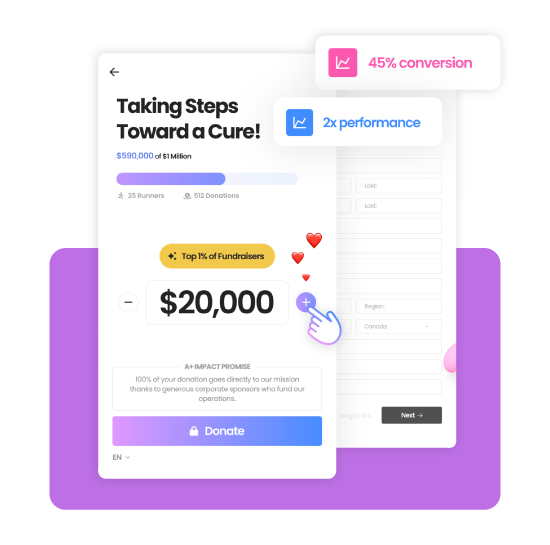
With Givecloud + DonorPerfect, you can design impact-first donation forms that allow donors to connect to outcomes before dollar amounts.
Learn more about how Givecloud’s high-converting online donation forms integrate with DonorPerfect to streamline the giving experience and grow online revenue by up to 72%.
4. Personalize the giving experience
As discussed above, donors are more likely to give when they feel a personal connection to your cause.
A one-size-fits-all approach can feel impersonal, especially in a digital environment where donors are accustomed to tailored experiences. Personalization helps bridge that gap by aligning your messaging and asks with each donor’s behavior and preferences.
Make the giving experience feel personal by:
- Customizing suggested gift amounts using donor data
- Tailoring outreach for different donor segments
- Creating campaign-specific landing pages for different audiences
- Adjusting communication flows based on donors’ engagement history
When donors feel that your message speaks directly to them, they’re more likely to take action.
Pro tip: Use the donor data in your fundraising CRM to automate personalized outreach that feels human and relevant—while saving your team valuable time.
Drive more online donations with built-in email and digital marketing for nonprofits
Effective online campaigns rely on consistent, targeted communication—but many CRMs separate donor outreach from valuable donor data.
DonorPerfect and Constant Contact work together, enabling organizations to manage nonprofit email marketing, donor segmentation, and campaign performance all within one connected fundraising system.
When donor management and digital marketing are combined, nonprofits can:
- Create and send targeted fundraising campaigns with built-in segmentation
- Automate appeals, acknowledgments, and follow-ups
- Track email engagement, campaign performance, and donation activity together
- Deepen donor relationships with personalized, data-informed outreach
The result: On average, nonprofits using DonorPerfect’s integration with Constant Contact see 31% higher email open rates and 2.1x more click-throughs than the industry standard.
5. Extend the experience with digital donor stewardship
A donor’s giving experience shouldn’t end the moment they complete their gift. Rather, that moment should mark the beginning—or continuation—of an ongoing and meaningful relationship with your mission.
What happens immediately after a donation plays a critical role in shaping how donors feel about their decision and whether they will give again. A strong digital stewardship strategy ensures they feel recognized for their contribution, connected to the cause, and motivated to stay engaged.
An effective post-donation experience should:
- Acknowledge the gift quickly and personally
- Reinforce the impact of the donation
- Provide clear next steps for continued donor engagement
And while email is the most common channel for consistent stewardship, consider additional digital tools that can help you acknowledge supporters and convey impact in creative ways.
Here are a few ideas:
- A text message updating the donor on your campaign progress
- A personalized thank-you video from a beneficiary
- A social media post thanking campaign donors
Over time, interactions like these can build trust and increase the likelihood of donor retention and recurring giving.
Bring your mission to life with built-in video fundraising
Video can help nonprofits connect more deeply with donors wherever they are—but too often, creating and sending videos involves time-consuming manual uploads and disconnected data tracking. DP Video lets you create and send personalized video messages from donor records, with engagement tracked in DonorPerfect—so you can connect faster and see how donors interact with your outreach.
Integrated video helps nonprofits:
- Personalize donor outreach for higher engagement and response rates
- Send one-to-one video messages without leaving DonorPerfect
- Thank donors by showing the impact of their generosity
- Track video performance alongside donor data
The result: Stronger donor relationships, deeper engagement, and a more connected online fundraising strategy.
As in traditional fundraising, online fundraising is about creating meaningful experiences that align with how donors think and act.
When you understand the psychology of online giving, you can move beyond guesswork and start designing strategies that:
- Build connection from the first interaction
- Reinforce trust throughout the giving process
- Remove friction that prevents donors from completing gifts
- Continue the relationship long after a donation is made
With DonorPerfect, nonprofits can bring these strategies to life using integrated online donation forms, automated outreach, and donor insights to create personalized experiences that motivate lasting generosity.
Free Guide: The Donation Form Optimization Checklist
Learn 25 simple strategies that reduce friction, increase giving, and improve conversion rates.