






Your Fundraising Superpower For a Plan That Actually Works
Contributed by T. Clay Buck, Founder & Principal of Next River Fundraising Strategies
We tend to think of fundraising as a linear process—find a donor, ask for a gift, send a receipt. Even our standard Donor Lifecycle reads like a cause-and-effect process:
Identify → Qualify → Cultivate → Solicit → Steward.
If you’ve been in any level of fundraising for a minute, you’ve learned that it doesn’t always work like that. Donors come and go, they skip steps, and they take longer than expected.
Internally, our processes aren’t always straightforward either.
Sure, we think it’s “Get a gift, enter it into our nonprofit CRM, send a receipt.” But if we zoom out a bit and look at the whole, we see it’s a lot more than that. There’s reconciliation with finance, tracking results overall, reviewing metrics, printing receipts and acknowledgements, not to mention the whole stewardship process that’s dependent upon gift entry.
These are what we call systems, which led to a management technique called, rather obviously, “systems thinking.”
Systems thinking is an approach to understanding processes as an interconnected whole, rather than isolated, independent parts. It looks at root causes, not just symptoms, and attempts to solve problems from a long-term framework.
What is systems thinking?
“A system is a group of interacting and interrelated parts that form a unified whole in order to achieve a specific purpose.” – Daniel H. Kim, Introduction to Systems Thinking
How does this relate to fundraising? You’re not managing isolated tasks or one-off activities. You’re working inside a system.
Systems thinking helps you see how those parts connect. It helps you understand how your processes, your data, your team, your donors, your timing, and your decisions interact with each other to create the results you experience. It reveals why some efforts feel smooth, and others feel impossible. It shows you where pressure builds, where delays begin, and where small changes create meaningful improvements.
This perspective is essential for nonprofit strategic planning because fundraising never behaves like a straight line. It behaves like a system. And when you understand that system, you can build a fundraising plan that works in real life rather than only on paper.
Recognize the three parts every system must have
All systems share three essential characteristics. Each one applies directly to fundraising and to nonprofit strategic planning.
1) A system serves a purpose
Every system exists to produce a result. The result may be intentional or unintentional. Either way, the system performs exactly as it is designed. Your fundraising system produces the outcomes you see today because that is what the structure is built to produce.
If your system regularly runs behind schedule, that is the purpose it currently serves. If your messages frequently get delayed in review, that is the purpose it currently serves. If your donor segments are inconsistent because data is inconsistent, that is the purpose the system serves.
This can feel frustrating until you realize it is also liberating. Because if a system can serve one purpose, it can be redesigned to serve another purpose. And that is where nonprofit strategic planning becomes powerful.
2) A system requires all essential parts to be present
A system only works when every vital component is present and functioning. If even one part is missing, the system cannot achieve its purpose. Fundraising systems rely on parts such as a clear message, strategy, strong data quality, accurate segmentation, cross-team communication, realistic timelines, supportive technology, and a shared understanding of donor identity.
When one part is missing, the entire system strains. A brilliant message cannot overcome a weak list. A strong case for support cannot overcome a bad timeline. A motivated team cannot overcome inconsistent data.
The parts interact. Weakness in one area creates drag in every other area. This is why a fundraising plan that focuses only on content, or only on deadlines, or only on goals, never works as well as expected. The system needs all its parts.
3) A system maintains stability through feedback
All systems respond to feedback. Feedback is the information a system uses to keep itself functioning. In fundraising, feedback comes from donor behavior, staff workload response rates, project delays, recurring bottlenecks, and even your own instincts about what feels harder than it should.
Feedback is not criticism. Feedback is the system talking to you. When donors respond warmly, that is feedback. When an email falls flat, that is feedback. When the team loses time due to a predictable process failure, that is feedback.
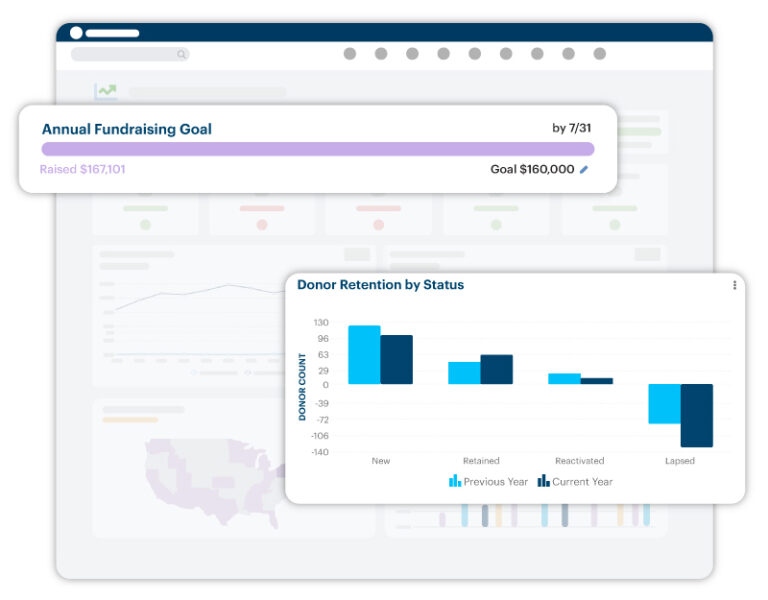
Your nonprofit CRM dashboard is one of the strongest, most effective feedback loops you have. Ignoring feedback creates instability. Listening to feedback makes the system stronger.
Rely on real-time insights to make strategic decisions. With a nonprofit CRM like DonorPerfect, you can create customized dashboards to:
- Set annual fundraising goals
- Track key performance indicators
- Analyze your general ledger
- View and filter fundraising reports
- Create graphs for your team
See how systems thinking changes the way you plan
Once you understand the purpose of your system, the parts it needs, and the feedback it uses, you begin to see your fundraising work differently. You stop expecting your plan to move in a straight line. You recognize that fundraising is not linear. It moves in loops. It accelerates and slows down. It gets stuck. It shifts based on factors you cannot control. And all of this is normal.
Systems thinking does not make the work easier. It makes the work understandable. And when fundraising becomes understandable, it becomes far easier to plan.
Apply systems thinking to your fundraising plan
Here are a few places where systems thinking becomes your strategic advantage.
- Look for the point where work always gets stuck. That is a systems clue.
- Notice when donor response patterns repeat. That is feedback.
- Identify tasks that take more time than you expect. That reveals missing parts.
- Pay attention to moments of ease. Those are strengths to build on.
- Watch for ripple effects. If one small issue disrupts several steps, that issue is part of the system, not the task.
When you apply systems thinking you build a fundraising plan that is honest about how your system behaves. You also reduce unnecessary stress because you stop assuming every disruption is your fault. Disruptions are signals from the system. They are invitations to adjust, not reasons to blame yourself.
Let systems thinking guide your next year
Nonprofit strategic planning becomes dramatically more effective when you use systems thinking as the foundation. Instead of guessing what might work you use the behavior of your system to tell you what will work. You understand where to focus your energy. You understand which parts matter most. You understand how your donors respond and what the system needs to support them.
This is how you build a fundraising plan that actually has a chance to succeed. Not because everything will go perfectly, but because the plan is designed to work with reality rather than against it.
If you want help applying systems thinking in a practical step-by-step way, keep an eye out for our upcoming e-book, Data-Informed Planning for Fundraising Success. It will walk you through the simplest ways to analyze your system and use those insights to shape a stronger year ahead.
Download your free e-book
How to Use Data to Manage Your Nonprofit




Follow us on social!