






In the nonprofit sector, DEI (Diversity, Equity, & Inclusion) work refers to initiatives that promote safety, advocacy, and belonging for nonprofit employees and donors of color, especially in professional and educational settings. Recent studies show that many organizations fall short in this fight, lacking an understanding of the level of inclusivity necessary to properly represent the communities they serve.
In other words, how can you effectively serve your community if you look nothing like them, or haven’t fully grasped what they go through? Let’s take this time to learn from nonprofit professionals of color who are leading the conversation about diversity, equity, and inclusion in fundraising.
Lesson 1: What is needed & expected of today’s nonprofit organizations?
Tycely Williams, CFRE
Chief Development Officer, The Bipartisan Policy Center
2021 DonorPerfect CommUNITY Conference speaker
A few months into one of her previous nonprofit roles, Williams realized that the job would be “an emotionally and psychologically draining experience,” explaining that “many of the tactics that were in place worked for white people. The culture was shaped by white people. The measures of success were defined by white people.”
As the only Black woman in a leadership position at a large organization, no matter which approach she took, she felt it was difficult to get support from her team, she recalls. When she tried to lead from the front, she was “too aggressive” and “wasn’t bringing people along.” When she tried to lead from the side, she was told, “You’re not showing enough leadership; your team needs more from you.” When she tried to lead from behind, she heard, “You’re not showing that you’re capable and competent or prepared.”
To her point, making people of color feel included and appreciated cannot and will not happen overnight. And it’s important that the nonprofit sector understands that simply hiring a more diverse nonprofit staff will not make this happen.
Strategies for Engaging Racially + Culturally Diverse Donors >>
Angelique S. C. Grant, PhD.
Vice President of the Aspen Leadership Group
Certified diversity recruiter
“You can attract a diverse group of professionals all day and night, but that doesn’t necessarily mean that they’re going to feel welcome when they arrive,” says Grant. “If no one really wants to be inclusive, what does it really matter if it’s diverse at that point?”
To deepen their understanding, experts say nonprofit professionals and employees need to look beyond base-level diversity and awareness to learn more about the flawed systems that created this deficit in the first place.
Kim Nyoni
Vice President of Philanthropy at University of Nevada Las Vegas
“Time and time again we see society awakened and shocked by [current events],” Nyoni says. “But oftentimes we ignore the unconscious biases and institutionalized racism that prevent everybody from faculty getting tenure to professionals of underrepresented groups having the opportunity to fulfill their dreams professionally.”
Nyoni encourages nonprofit professionals “to begin rooting out these problems and create better institutions,” or walk the walk.

Lesson 2: How can organizations align hiring with diversity goals?
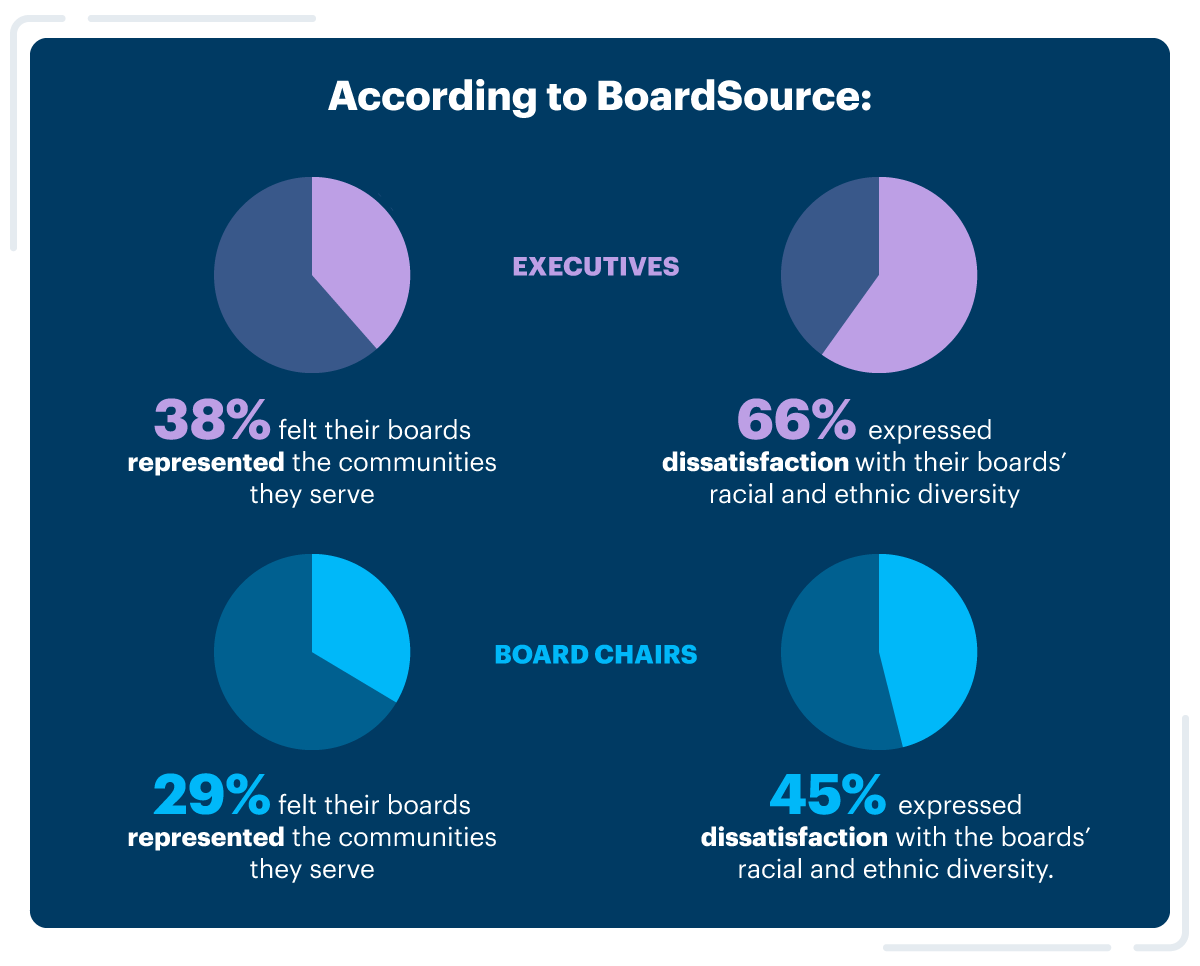
In their 2021 report, Leading with Intent, BoardSource reports:
- While boards might be getting slightly more diverse, they are far from representing the communities they serve.
- Board recruitment practices are not aligned with diversity goals.
- Boards that include people of color are more likely to have adopted Diversity, Equity, & Inclusion (DEI) practices than boards that do not.
Peter Hayashida
President, University of California Riverside Foundation
Since 2009, Hayashida has worked to diversify his own team from one that was largely white to one that reflects the racial and ethnic demographics of the nation. Of the 40 fundraisers on staff right now, 45 percent identify as nonwhite.
“The profession needs to look beyond ‘I can’t worry about DEI today because I have a fundraising goal to meet and I just have to hire the best people,’” he says. “That’s all code for ‘I’m going to hire the people who’ve already done the job,’ which by definition means ‘I’m going to hire more people who look like the people I already have.’”

“If we don’t start looking more like our student bodies, we will lose credibility,” he says. “When we go out seeking support, people will say, ‘You say you care about students of color, but I don’t see any people coming to talk to me who seem to have a lived experience that would give them insight into what my experience might have been like as a Black student at UC Riverside in the 1970s.’”
Eva Aldrich
President & CEO of CFRE International
“Organizations that budgeted for IDEA (Inclusion, Diversity, Equity, & Access) work had employees who were five times more likely to report progress in IDEA values and policies. The study shows the importance of making a commitment of time and money to bring about social justice,” says Aldrich.
Lesson 3: How can nonprofits implement and maintain DEI/IDEA policies?
Based on a recent study, the Association of Fundraising Professionals’ Inclusion, Diversity, Equity, & Access (DEA) collaborative believes fundraisers will benefit from stronger leadership, intentional support of staff, and deliberate policies and practices related to IDEA. In this study, more than half of respondents said their organization lacks resources to create, implement, and review IDEA policies.
The following are AFP’s IDEA principles:
- Recognition of others as different but equal.
- Respect and empathy for all.
- Trust and integrity that facilitate the integration of different and multiple voices in organizational discourse.
- Demonstrated appreciation for different voices, active listening; openness to disparate viewpoints and opinions, and facilitating dialogues among the diverse groups.
- Practicing and encouraging transparent communication in all interactions.
- Developing participative decision making; problem-solving; and, team capabilities.
- Exploring potential underlying, unquestioned assumptions that interfere with inclusiveness.
AFP IDEA suggests the following groundwork to get started:
- Improve overall organizational activities.
- Consider “diversity” in all its aspects.
- Commit to an inclusive process to create and disseminate well-defined written policies that address IDEA.
- Support the career aspirations of colleagues, including access to promotions and greater responsibility.
- Respond clearly and quickly to concerns, and have consequences for people who offend through discrimination, bias, or micro-aggressions.
- Invest in IDEA as a method of capacity-building.
- Be deliberate about equitable hiring.
- Pay attention to supporting equity and inclusiveness throughout the organization.
Here at DonorPerfect, we stay committed to these principles with the help of our Diversity & Inclusion Steering Committee. Each month, our D&I team provides learning opportunities and resources relating to unconscious biases and the many layers of our society – in the U.S. and internationally – that contribute to institutionalized racism.